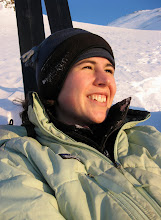



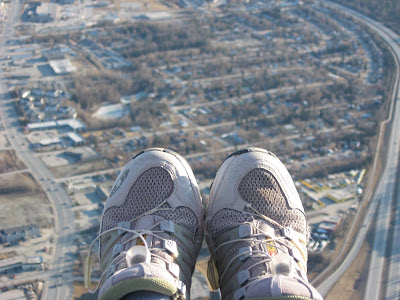
Paragliding high in Eagle River's sky
Here's the next installment in the periodic outdoor adventure series, called Outside the Ordinary, that I write for the Alaska Star. This article was published in May ... it's taken me a bit to get it up on the blog. (The story is below the photos).




By Amy Schenck
Alaska Star
It’s a ubiquitous late spring and early summer sight: brightly colored dots suspended in the skies above Eagle River.
A handful of local residents make paragliding more than a pastime, they make it a lifestyle.
Scott Amy fits this bill. He has been certified to paraglide for almost two decades, and has worked as an instructor for nearly as long. When not soaring with his glider, he can be found piloting planes - and more recently - helicopters.
Scott offered to take me out on a tandem flight April 21 to give me an off-the-ground feel for what the sport is all about.
We met at the McDonald Center in the late afternoon, near a large open landing field, and caravanned to Mount Baldy’s trailhead. Seven paragliders had already launched into the blue canvass above - a sure sign that conditions were ripe.
On the drive Scott gave me a few pointers and explained how to launch: wait for his cue, run until you’re feet are flapping above the alders and keep you’re weight forward, he instructed.
Once in the air, I would need to help maneuver the flexible aircraft through leaning my body weight to the “left,” “far left,” “right” and “far right,” he continued.
We also discussed thermals, the mysterious rising air currents that would keep us aloft - mysterious to me anyway, there’s actually quite an in-depth body of scientific knowledge on how thermals work - as I later learned from talking to Scott and reading a book about paragliding.
To put thermals into elementary terms, the sun hits the ground, the ground heats the air, the heat rises and we, the paragliders, catch that upward lift.
But watch out! On either side of a thermal, cold air sinks toward the ground in a mad dash to fill the space left behind by the warm air.
Throw wind into the equation, and now you have upward and downward currents being tossed this way and that by sideway currents.
The moral: it takes some skill to handle a glider.
At the Baldy parking lot, we grabbed our gear - glider, harnesses, helmets, reserve parachute, warm clothes, water and a device called a vario, which is short for variometer; it tracks distance traveled and tells the pilot the rate of climb or descent. We then headed for the launch site.
Baldy touts convenience. The launch site - a grassy knoll - is but a 5-minute walk from the trailhead.
As we arrived, we waved at a fellow paraglider circling overhead. We then put on our harnesses and spread out our wing. After ironing out a few minor tangles in the line, we clipped into the glider. I waited for Scott to read wind direction and other air movements, and then give the go ahead.
On Scott’s cue we ran forward; a few seconds later wind pulled us backward; Scott kited the wing into the oncoming gust; we once again took a few steps forward, and within seconds lifted softly into the sky - a far cry from the so-called thrill jump many envision when they think of paragliding.
“Wow!” I thought. “Wow!” I thought again, and dozens of more times after that.
Crystal clear doesn’t fully describe the day. The Alaska Range jutted out of the horizon and Mount Redoubt puffed proudly to the south.
We began caressing the side of Eagle River’s landmark mountain, zooming back and forth in search of the magic thermals (Again, magic to me).
A light wind knocked the thermals around, making upward mobility a bit of a scavenger hunt.
Luckily we had a clue: follow the bald eagle swooping easily through the air.
We began to find thermals. When we hit them, we immediately spun the glider into a tight twist, riding the air column up. To spin we pulled one side of the wing in and shifted our body weight “far left” or “far right.”
Scott called it an air dance - a fitting description and great way to think about the sport.
After some time and work, we climbed above Baldy’s peak into the peaceful void beyond, where we heard nothing more than the vario’s soft beep, letting us know when we gained or lost elevation.
Total freedom, total quiet and a totally cool view! Eagle River seemed to be nothing but an ant farm, with Denali the ants’ hill.
An hour or so later we steered the glider toward our landing pad next to the McDonald Center. (I use the term “we” with a note of pride, as Scott let me take control of the aircraft for some minutes.)
When it was time to land we hovered far above an open field, eyeing an orange windsock. And then - in the same way we climbed high - we pulled into a tight spiral, catching cold, sinking air.
Warning: this activity is not for the faint of stomach, as evidenced by a not-so-delightful little mess I left on the ground - thankfully after touchdown. (I hear you adjust to the twirling and spinning after a few flights).
Before landing we shook out our legs, preparing to once again carry our own weight, and then floated onto the ground running.
We rolled up the glider methodically, carefully attending to the strings and removing air from beneath the folds in the rip stop nylon fabric.
Sun still showered the area as we threw our gear into the car and headed home.
Alaska Paragliding and Midnight Sun Paragliding offer lessons and tandem flights in Southcentral Alaska. Learning how to paraglide costs $1,500 and includes about 75 hours of hands-on training, ground work and a couple of written tests. Lessons include three to four tandem flights at different stages, with the first few days of instruction spent on shallow slopes and flat ground learning how to handle the glider.
Scott recommends taking an introductory tandem flight before deciding if you want to invest time and money into lessons.
The schools use several sites for training, spreading from Gridwood to the Mat-Su Valley.
“The training can be done safely, as can the flying, proved by many with thousands of flights and years of flying with no injury,” Scott said.
What kind of person flies a flexible aircraft?
“Most would be surprised to know that the most common demographic is men 40 to 60 years old. There are a few young guys, but for the most part it’s mid-aged professionals and a few fortunate retired folks, from every walk of life you can imagine,” Scott said.
There are about 70 members of the Arctic Airwalker Association, and about 10 of them are women pilots.
In spring and early summer Eagle River paragliders often gain a couple of thousand feet in elevation and take cross-country trips down Eagle River Valley, or to farther away destinations like Turnagain Arm or Chikaloon.
For more information about paragliding visit: www.alaskaparagliding.com, www.midnightsunparagliding.com and www.arcticairwalkers.com.


By Amy Schenck
Alaska Star
It’s a ubiquitous late spring and early summer sight: brightly colored dots suspended in the skies above Eagle River.
A handful of local residents make paragliding more than a pastime, they make it a lifestyle.
Scott Amy fits this bill. He has been certified to paraglide for almost two decades, and has worked as an instructor for nearly as long. When not soaring with his glider, he can be found piloting planes - and more recently - helicopters.
Scott offered to take me out on a tandem flight April 21 to give me an off-the-ground feel for what the sport is all about.
We met at the McDonald Center in the late afternoon, near a large open landing field, and caravanned to Mount Baldy’s trailhead. Seven paragliders had already launched into the blue canvass above - a sure sign that conditions were ripe.
On the drive Scott gave me a few pointers and explained how to launch: wait for his cue, run until you’re feet are flapping above the alders and keep you’re weight forward, he instructed.
Once in the air, I would need to help maneuver the flexible aircraft through leaning my body weight to the “left,” “far left,” “right” and “far right,” he continued.
We also discussed thermals, the mysterious rising air currents that would keep us aloft - mysterious to me anyway, there’s actually quite an in-depth body of scientific knowledge on how thermals work - as I later learned from talking to Scott and reading a book about paragliding.
To put thermals into elementary terms, the sun hits the ground, the ground heats the air, the heat rises and we, the paragliders, catch that upward lift.
But watch out! On either side of a thermal, cold air sinks toward the ground in a mad dash to fill the space left behind by the warm air.
Throw wind into the equation, and now you have upward and downward currents being tossed this way and that by sideway currents.
The moral: it takes some skill to handle a glider.
At the Baldy parking lot, we grabbed our gear - glider, harnesses, helmets, reserve parachute, warm clothes, water and a device called a vario, which is short for variometer; it tracks distance traveled and tells the pilot the rate of climb or descent. We then headed for the launch site.
Baldy touts convenience. The launch site - a grassy knoll - is but a 5-minute walk from the trailhead.
As we arrived, we waved at a fellow paraglider circling overhead. We then put on our harnesses and spread out our wing. After ironing out a few minor tangles in the line, we clipped into the glider. I waited for Scott to read wind direction and other air movements, and then give the go ahead.
On Scott’s cue we ran forward; a few seconds later wind pulled us backward; Scott kited the wing into the oncoming gust; we once again took a few steps forward, and within seconds lifted softly into the sky - a far cry from the so-called thrill jump many envision when they think of paragliding.
“Wow!” I thought. “Wow!” I thought again, and dozens of more times after that.
Crystal clear doesn’t fully describe the day. The Alaska Range jutted out of the horizon and Mount Redoubt puffed proudly to the south.
We began caressing the side of Eagle River’s landmark mountain, zooming back and forth in search of the magic thermals (Again, magic to me).
A light wind knocked the thermals around, making upward mobility a bit of a scavenger hunt.
Luckily we had a clue: follow the bald eagle swooping easily through the air.
We began to find thermals. When we hit them, we immediately spun the glider into a tight twist, riding the air column up. To spin we pulled one side of the wing in and shifted our body weight “far left” or “far right.”
Scott called it an air dance - a fitting description and great way to think about the sport.
After some time and work, we climbed above Baldy’s peak into the peaceful void beyond, where we heard nothing more than the vario’s soft beep, letting us know when we gained or lost elevation.
Total freedom, total quiet and a totally cool view! Eagle River seemed to be nothing but an ant farm, with Denali the ants’ hill.
An hour or so later we steered the glider toward our landing pad next to the McDonald Center. (I use the term “we” with a note of pride, as Scott let me take control of the aircraft for some minutes.)
When it was time to land we hovered far above an open field, eyeing an orange windsock. And then - in the same way we climbed high - we pulled into a tight spiral, catching cold, sinking air.
Warning: this activity is not for the faint of stomach, as evidenced by a not-so-delightful little mess I left on the ground - thankfully after touchdown. (I hear you adjust to the twirling and spinning after a few flights).
Before landing we shook out our legs, preparing to once again carry our own weight, and then floated onto the ground running.
We rolled up the glider methodically, carefully attending to the strings and removing air from beneath the folds in the rip stop nylon fabric.
Sun still showered the area as we threw our gear into the car and headed home.
Alaska Paragliding and Midnight Sun Paragliding offer lessons and tandem flights in Southcentral Alaska. Learning how to paraglide costs $1,500 and includes about 75 hours of hands-on training, ground work and a couple of written tests. Lessons include three to four tandem flights at different stages, with the first few days of instruction spent on shallow slopes and flat ground learning how to handle the glider.
Scott recommends taking an introductory tandem flight before deciding if you want to invest time and money into lessons.
The schools use several sites for training, spreading from Gridwood to the Mat-Su Valley.
“The training can be done safely, as can the flying, proved by many with thousands of flights and years of flying with no injury,” Scott said.
What kind of person flies a flexible aircraft?
“Most would be surprised to know that the most common demographic is men 40 to 60 years old. There are a few young guys, but for the most part it’s mid-aged professionals and a few fortunate retired folks, from every walk of life you can imagine,” Scott said.
There are about 70 members of the Arctic Airwalker Association, and about 10 of them are women pilots.
In spring and early summer Eagle River paragliders often gain a couple of thousand feet in elevation and take cross-country trips down Eagle River Valley, or to farther away destinations like Turnagain Arm or Chikaloon.
For more information about paragliding visit: www.alaskaparagliding.com, www.midnightsunparagliding.com and www.arcticairwalkers.com.
Labels: Alaska, Alaska Star, Amy, articles, Chugach mountains, Eagle River, My publications, Outside the Ordinary, Paragliding, photos, spring, story
posted by Amy | 9:56 PM
|
0 comments


